
Key Takeaways
- A true stem cell hair transplant, where lab-processed follicular cells are implanted, remains investigational and is not approved anywhere.
- What clinics sell as stem cell hair treatment is an injectable protocol that supports existing follicles. It does not create new ones.
- Published trials show density gains in the region of 28 to 29 percent, measured over roughly four to six months, in small studies.
- Follicle viability, not visible baldness, decides whether you are a candidate.
- Surgery moves the hair you still have. Regenerative treatment protects the hair you have not lost yet. Most patients eventually need to think about both.
Table of Contents
If you have spent an evening searching for a stem cell hair transplant, you have probably come away more confused than when you started. One page tells you the procedure only exists in research labs. The next one is a clinic offering to book you in next Tuesday. Both are describing something real. They are just describing two completely different things, and almost nobody bothers to say so.
That gap is worth closing, because the decision you are actually making is not “should I get stem cells for my hair.” It is “which of these two very different procedures matches the state of my scalp right now.”
The Two Things People Mean by “Stem Cell Hair Transplant”
Here is the distinction that clears up most of the confusion.
1. The true stem cell hair transplant, which is still investigational
This is the version researchers are chasing. Instead of harvesting thousands of individual follicles from the back of your head, a surgeon takes a small skin sample. In a lab, follicular cells are separated out, cultured or processed into a cell suspension, and then implanted back into thinning areas. The theory is that both the donor site and the recipient site end up growing hair, which would remove the single hardest limit in hair restoration: donor supply.
It is a genuinely exciting idea. It is also not an approved procedure anywhere. No regulator, the FDA included, has cleared a cultured stem cell hair transplant as a standard treatment. Work published by Gentile and colleagues in 2017 and later trials using autologous hair follicle mesenchymal stem cell suspensions have shown measurable improvements, but these remain research protocols with small patient numbers.
2. The stem cell hair treatment you can actually book today
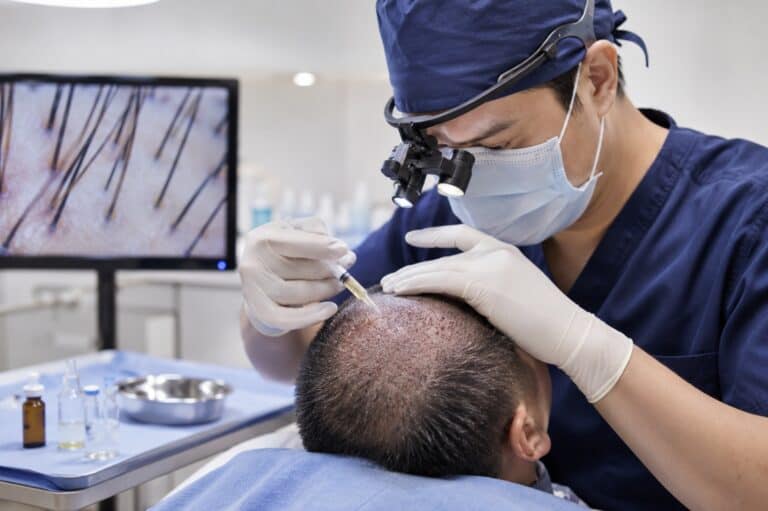
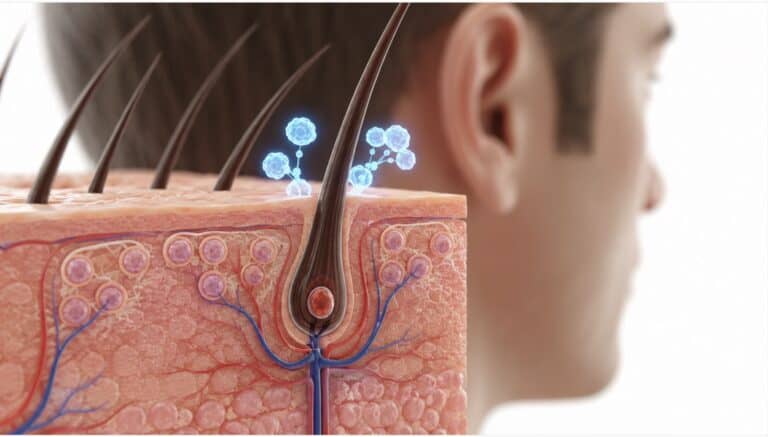
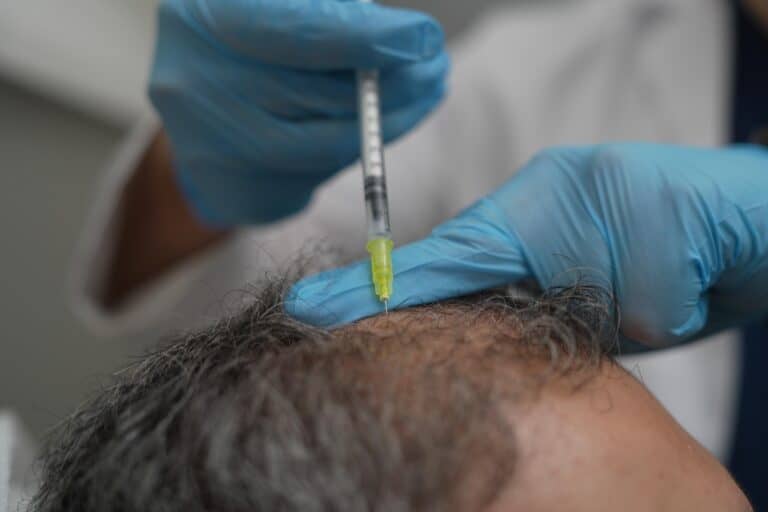
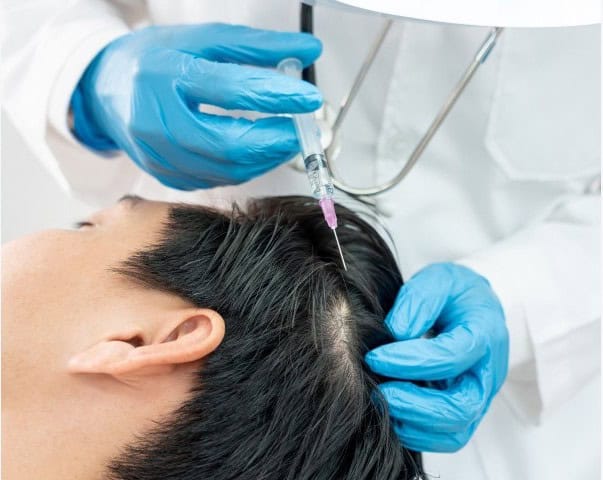
This is what almost every clinic advertising “stem cells for hair” is really offering. Nothing is transplanted. Instead, cell-derived material, usually a secretome, conditioned medium, or growth factor preparation, is delivered into the scalp to influence the follicles you already have.
It does not create new follicles. It works on the biology around existing ones: blood supply, inflammation, and the signals that tell a follicle whether to keep producing thick hair or drift toward a thinner, shorter cycle. At Vegaderma this sits inside our Follicular Signaling Enhancement (FSE) protocol, and it is a very different proposition to surgery.
Once you separate those two, the rest of the research starts making sense.
Stem Cell Hair Treatment vs the Alternatives
Patients rarely compare stem cell treatment against a lab procedure. They compare it against the things sitting next to it on a clinic menu. That comparison is more useful.
| Approach | What it actually does | Creates new follicles? | Best suited to |
|---|---|---|---|
| FUE hair transplant | Physically relocates living follicles from donor to thinning zones | No, it redistributes what you have | Established bald or near bald areas with a solid donor supply |
| Stem cell hair treatment | Delivers cell-derived signaling material to support existing follicles | No | Miniaturising or thinning hair that is still alive |
| PRP | Concentrates your own platelets and their growth factors | No | Early thinning, often as a lower cost entry point |
| Exosome therapy | Uses isolated cell signaling vesicles rather than whole cells | No | Similar cases to stem cell treatment, with a different preparation |
| Cultured stem cell transplant | Lab-expanded follicular cells implanted into the scalp | Potentially, in theory | Nobody yet, outside clinical research |
Notice the pattern. Only one row on that table promises new follicles, and it is the row you cannot book. If a clinic tells you their injectable stem cell treatment will regrow hair on a fully bald scalp, that claim has quietly jumped rows.
We have written separately on how PRP and FSE differ in practice and on what actually separates exosomes from stem cell therapy.
What the Research Numbers Actually Say
The published figures are encouraging without being miraculous, and the honest version is more useful to you than the marketing version.
- The 2017 Italian study reported roughly a 29% increase in hair density at 23 weeks after the final treatment.
- A South Korean randomised, vehicle-controlled trial using adipose-derived stem cell constituent extract reported around a 28% increase in density at 16 weeks.
- A systematic review and meta-analysis of stem cell derived conditioned medium pooling eight trials found a mean improvement of roughly 15 hairs per square centimetre against controls.
- A broader systematic review of human stem cell use in androgenetic alopecia found density benefits across several cell sources, with a generally favourable safety profile.
Three things are worth pulling out of those numbers.
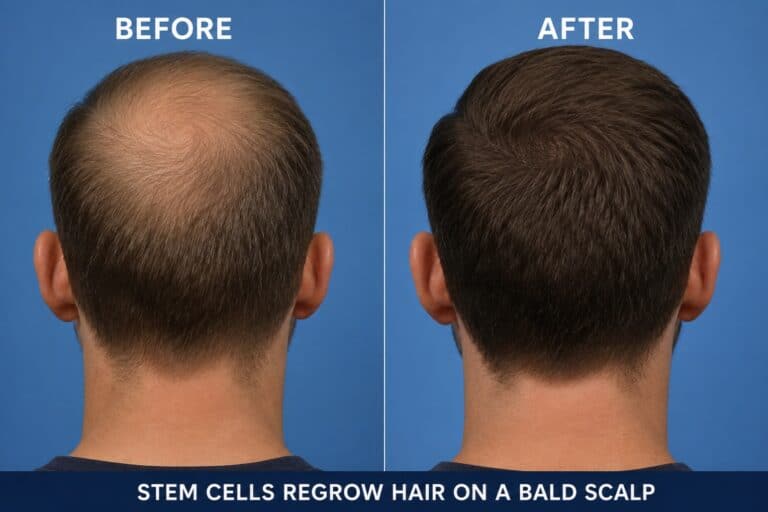
They are percentage gains, not transformations. A 28% density improvement on a thinning crown is visible and meaningful. On a scalp that has been smooth for a decade, 28% of very little is still very little.
The follow up windows are short. Most sit between 16 and 24 weeks. That tells you the treatment works in that window. It does not tell you what happens at year three without maintenance.
Sample sizes are small. These are early-phase studies, not the thousands-of-patients trials behind approved drugs. That is exactly why regulators still class this as investigational, and why any clinic quoting you a fixed success rate is quoting something the literature does not support. We unpack this further in our piece on what stem cell success rates actually mean.
Who This Genuinely Suits, and Who It Does Not
This is the section most articles skip, and it is the one that decides whether you waste your money.
Likely to benefit
- Early to moderate pattern thinning where hair is getting finer rather than disappearing
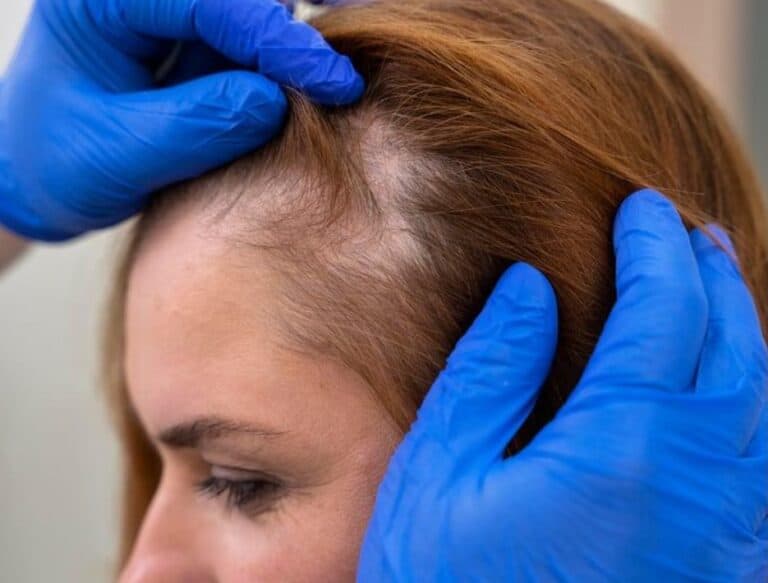
- Widening part lines and diffuse thinning, common in female pattern loss
- Patients who cannot tolerate or do not want long-term minoxidil or finasteride
- Post-transplant patients protecting native hair that surgery never addressed
Unlikely to benefit
- Fully bald areas where follicles have fibrosed and are no longer viable
- Scarring alopecias where the follicular structure itself has been destroyed
- Anyone expecting a single session to do the work of a transplant
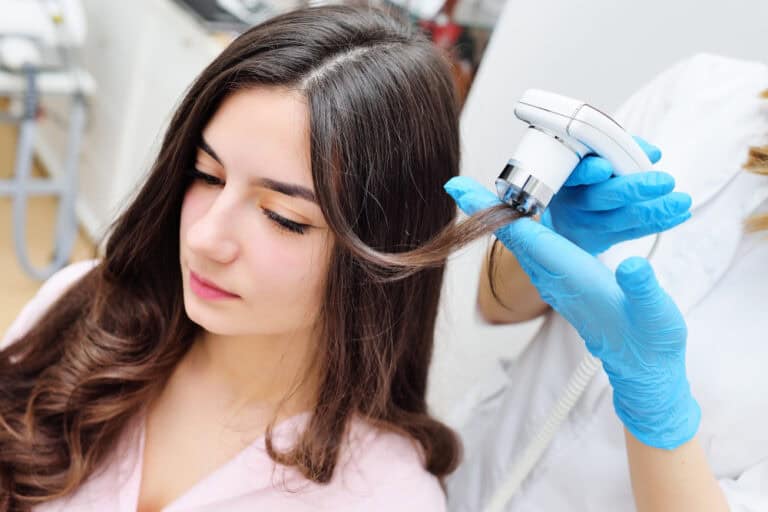
The dividing line is follicle viability, not how bald the area looks in the mirror. A scalp that appears smooth may still hold miniaturised follicles that respond. Another that looks similar may hold nothing. Only assessment under magnification, ideally with trichoscopy, tells you which one you are. We cover that assessment in detail in the follicle viability question.
The Regulatory Picture, Honestly
The FDA has not approved a stem cell treatment for hair loss, and it has issued consumer alerts on regenerative medicine products including stem cells and exosomes. That is accurate and worth knowing.
What it does not mean is that every clinic outside the United States is operating in a vacuum. Thailand regulates cell-based medical practice through its own medical council and ethics frameworks, and reputable clinics work inside them. The practical question is not which country you are in. It is whether the clinic in front of you will tell you plainly which parts of your plan are standard dermatological care and which parts are emerging regenerative support.
If a clinic cannot draw that line for you, that is your answer.
Questions Worth Asking Before You Pay
- Am I being offered an implantation procedure or an injection protocol? If the answer is vague, it is an injection protocol.
- What material is being used, and where does it come from? Autologous cells, donor-derived secretome, and exosome preparations are not interchangeable.
- What does my trichoscopy show about follicle viability in the target zone? A clinic that has not looked cannot answer this.
- How many sessions, over what period, and what does maintenance look like after that? Single-session offers rarely reflect how these protocols are studied.
- How will progress be measured? Standardised photography and density counts, not memory and good lighting.
- What happens if there is no response by month six? A clear exit point is a sign of a clinical plan rather than a sales one.
A Realistic Timeline
Assuming you are a reasonable candidate and following a multi-session protocol:
- Weeks 0 to 8: Treatment sessions. Often nothing visible. Some patients see a brief increase in shedding, which usually reflects follicles resetting their cycle rather than deteriorating.
- Months 3 to 4: Shedding settles. Early regrowth tends to appear as fine, short hairs that are easy to miss without baseline photos.
- Months 5 to 8: The window where most measurable density change shows up, matching the timeframes reported in the published trials.
- Months 9 onward: Assessment point. Either you have a response worth maintaining, or you have useful evidence that a different approach, possibly surgical, fits better.
For patients already planning surgery, timing matters more than most people realise. We covered how the two fit together in stem cell therapy around a hair transplant.
Where to Go From Here
If your hair is thinning rather than gone, a regenerative protocol is a reasonable conversation to have. If large areas have been bare for years, the honest answer is that transplantation is the tool that moves the needle, with regenerative support playing a protective role around it.
Our hair and scalp regeneration programme in Bangkok starts with assessment, not a package. You will be told which category your scalp falls into before anyone discusses treatment. Book a consultation if you would like that assessment.
Medical Disclaimer: Treatment outcomes vary between individuals. The information on this page is for educational purposes only and should not be interpreted as medical advice or a guarantee of results. A physician consultation is required to determine suitability for any treatment.
Frequently Asked Questions
-
What is a stem cell hair transplant in simple terms?
It is a procedure where a small skin sample is taken, follicular stem cells are separated in a laboratory, and that cell preparation is implanted into thinning areas. The aim is to grow hair at both the donor and recipient sites. It is still a research procedure and is not approved as a standard treatment.
-
Is a stem cell hair transplant the same as stem cell hair treatment?
No. A transplant implants processed cells. A stem cell hair treatment injects cell-derived signaling material into the scalp to support follicles that are already there. Most clinics offering "stem cells for hair" are offering the second one.
-
Can stem cell hair treatment regrow hair on a completely bald scalp?v
Generally no. If the follicles in that area are no longer viable, there is nothing for the treatment to act on. Areas that have been smooth for many years usually need a surgical approach instead.
-
How much does stem cell hair treatment cost?
Pricing varies widely by country, preparation, and number of sessions, and published figures for investigational procedures in the United States have been quoted anywhere from a few thousand to well over twenty thousand dollars. Any credible quote should come after an assessment, not before one.
-
Is it safe?
Reported side effects in the published trials have generally been mild and temporary, such as tenderness or minor swelling at the injection site. As with any injection there is a small risk of bleeding or infection. Safety also depends heavily on the standards of the clinic preparing and handling the material.
-
How long do the results last?
The underlying cause of pattern hair loss does not stop, so results are maintained rather than permanent. Most protocols assume periodic sessions to hold the gain, and the published follow-up windows are too short to answer the long-term question properly.
References:
- Gentile P, et al. (2017). Stem cells from human hair follicles: first mechanical isolation for immediate autologous clinical use in androgenetic alopecia and hair loss. ncbi.nlm.nih.gov/pmc/articles/PMC5504091
- Tak YJ, et al. (2021). A randomized, double-blind, vehicle-controlled clinical study of hair regeneration using adipose-derived stem cell constituent extract in androgenetic alopecia. stemcellsjournals.onlinelibrary.wiley.com
- Gan Y, et al. (2024). A clinical trial of treating androgenic alopecia with mesenchymal stem cell suspension derived from autologous hair follicle. pubmed.ncbi.nlm.nih.gov/37337324
- Talebzadeh AT, et al. (2023). Stem cell applications in human hair growth: a literature review. pmc.ncbi.nlm.nih.gov/articles/PMC10174680
- Stem cell derived conditioned medium for alopecia: a systematic review and meta-analysis. Journal of Plastic, Reconstructive and Aesthetic Surgery. jprasurg.com
- Human stem cell use in androgenetic alopecia: a systematic review. pmc.ncbi.nlm.nih.gov/articles/PMC10047891
- U.S. Food and Drug Administration. Consumer alert on regenerative medicine products including stem cells and exosomes. fda.gov

The Vega Derma Medical Team consists of board-certified dermatologists, specialized trichologists, and clinical researchers based in Bangkok, Thailand. Our team specializes in evidence-based regenerative dermatology, complex tissue repair, and advanced hair restoration (including precision FUE and FSE). Every protocol and article we publish is medically reviewed to ensure it meets international clinical standards, providing safe, science-backed guidance for our local and international patients.