
Introduction
If you look at a lot of hair restoration ads, you might notice that “exosomes” and “stem cells” are often used as if they mean the same thing. They are both marketed as top options for hair regrowth, but they are not the same. The difference matters because it affects what is actually injected into your scalp, how quickly a clinic can prepare it, how much research supports it, and what your treatment schedule will look like.
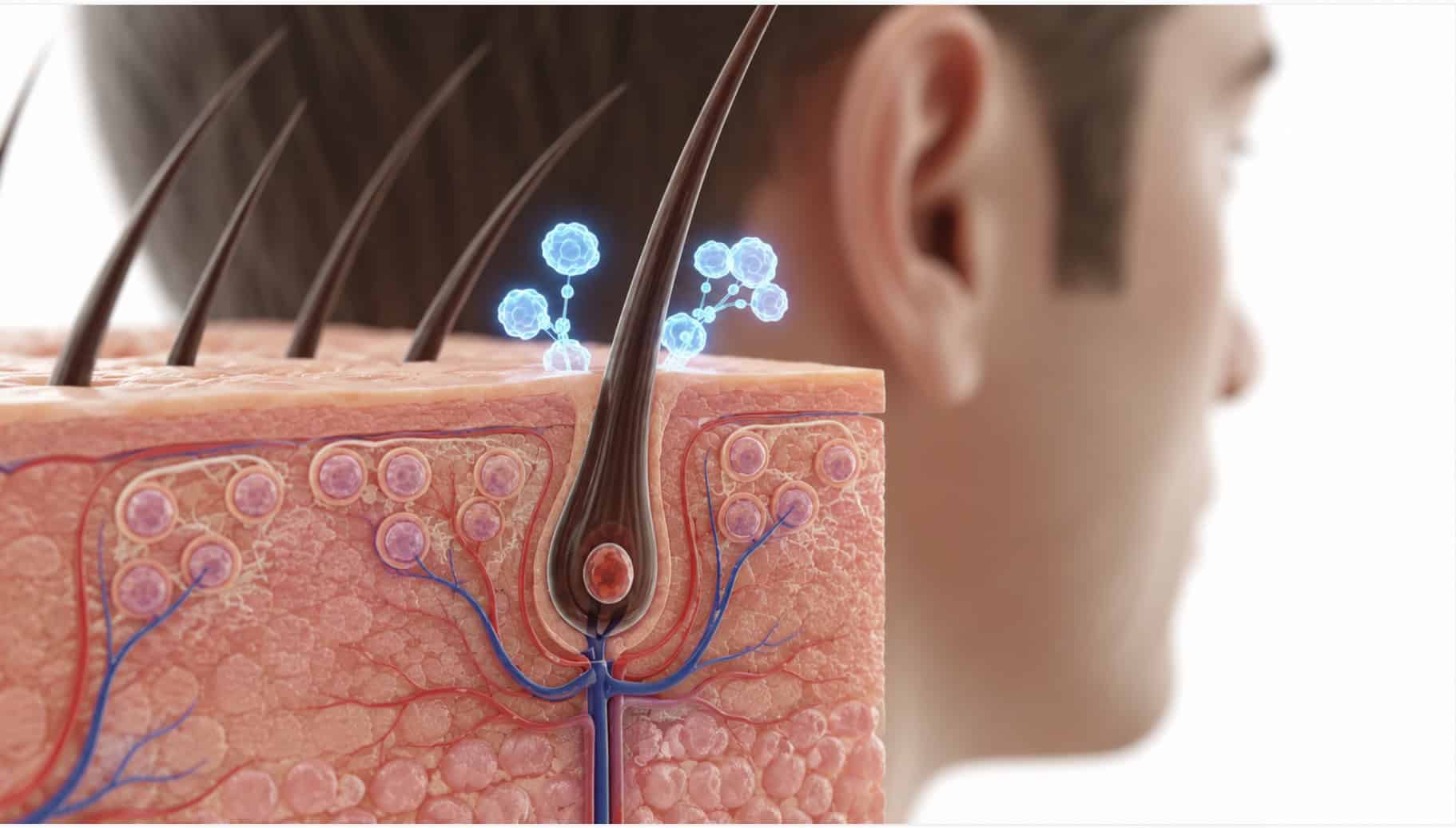
Here, we directly compare hair follicle regeneration using stem cell therapy and exosome therapy. We look at how each one works, how much evidence supports them, how many sessions you might need, what the maintenance schedule is, and the cost. This way, you can choose based on what each treatment actually offers, not just on which term sounds more impressive.
The Core Difference: Cells vs. Cargo
What Hair Follicle Regeneration Stem Cell Therapy Delivers
Hair follicle regeneration stem cell therapy uses living cells, usually mesenchymal stem cells (MSCs), derived from the patient’s own tissue or from carefully screened donors, such as umbilical cord (UC-MSCs) or adipose tissue. After these cells are placed near the hair follicle, they are meant to attach, survive, and release a wide range of growth factors and signaling molecules over time. Instead of delivering a one-time treatment, this therapy relies on a continuous biological process performed by cells that remain alive in the tissue for a period.
What Exosome Therapy Delivers
Exosome therapy does not use whole cells. Exosomes are small extracellular vesicles, which are tiny membrane-bound particles about 40 to 160 nanometers wide. Stem cells naturally release these vesicles to communicate with nearby tissue. Instead of introducing the entire cell, exosome therapy delivers a concentrated dose of the substances those cells would normally produce, such as growth factors, proteins, and microRNA fragments. Research has identified specific microRNAs, such as miR-181a-5p and miR-218-5p, that are associated with Wnt/β-catenin and IGF-1 signaling. These are the same pathways that need to be activated for dormant follicles to start growing again. With this approach, there are no living cells, no concerns about engraftment, and no need to manage cell survival. The therapy simply delivers a signaling package directly to the follicle environment.
Why the Distinction Matters Clinically
Here’s the main difference: stem cell therapy for hair follicle regeneration provides a living, ongoing source of biological signals. Exosome therapy, on the other hand, is a pre-packaged, single-dose of similar signals, but without the cell to keep making them. Neither one is automatically stronger. They are simply different tools, and this structural difference explains most of the other points in this comparison.
Comparing the Evidence Base
Where Stem Cell Evidence Currently Stands
Clinical evidence for stem cell therapy to regenerate hair follicles is still emerging. No regulatory body, including the US FDA or similar Western agencies, has approved a stem cell product specifically for hair restoration. Major hair-loss advocacy groups have also said they do not support stem cell treatments for hair loss unless they are part of well-designed clinical trials. This reflects the current regulatory and institutional position, not the science itself. Still, it is an honest starting point for anyone considering their options.
Where Exosome Evidence Currently Stands
The evidence supporting exosome therapy is still quite new. A 2025 clinical review found only a few studies focused on alopecia, involving about 100 patients in total. The review agreed with most current research that larger, controlled trials are needed before we can say the treatment works. Some case series have shown improvements in hair density, but these studies involved small groups and did not use the randomized, controlled trial designs needed for strong conclusions. At this time, no exosome product has regulatory approval for the treatment of hair loss.
The Honest Summary
Right now, both approaches are considered biologically plausible and are being actively studied, but they do not yet have the large-scale trial data needed for clinics to promise specific results. Anyone claiming either option is a proven cure is going beyond what current research supports.
Session Count and Maintenance Interval
Typical Stem Cell Protocol Structure
Hair follicle regeneration stem cell therapy usually involves fewer but more intensive sessions. In some cases, just one treatment with a high-cell dose is enough, since the cells are designed to continue working in the tissue after the session. Maintenance treatments are spaced further apart because the treated cells are expected to keep functioning without needing another dose right away.
Typical Exosome Protocol Structure
Exosome therapy usually involves a short series of three to four sessions, each spaced four to six weeks apart. After that, most people have a maintenance session about once a year. Since exosomes are given in a set amount and are not a living source that can renew itself, their effects gradually wear off and need to be refreshed on a regular schedule.
Comparing the Cost Bracket
Prices for both treatments can vary a lot depending on where you are, who provides the service, and the dose. However, the main price ranges are determined by the cost of producing each product.
Hair follicle regeneration stem cell therapy is usually the most expensive option for hair treatment. This is because of the costs involved in processing the cells, testing their quality, and making sure they are safe to use. Exosome therapy is often seen as a more affordable, non-surgical choice, with each session costing less than most stem cell treatments. However, if you need several exosome sessions and annual maintenance, the total cost can sometimes match or even exceed the price of a single stem cell session. If you combine treatments, such as adding exosomes to a hair transplant or using stem cell therapy with exosome maintenance, the price usually falls between the two main options.
Which Suits Which Stage: A Quick Reference
Factor | Hair Follicle Regeneration Stem Cell Therapy | Exosome Therapy |
Mechanism | Living cells, ongoing signal production | Cell-free vesicles, fixed signaling dose |
Evidence maturity | Early-stage, growing, not yet regulator-approved | Earlier-stage still, small studies, not yet approved |
Typical session count | Fewer, more intensive sessions | Short series (typically 3–4 sessions) |
Maintenance interval | Longer intervals between repeat treatment | Annual touch-up generally recommended |
Cost bracket | Higher per-session cost | Lower per-session, comparable across a full course |
Best-suited stage | Moderate, structurally-viable miniaturization with a higher regenerative budget | Early-to-moderate thinning, or as an adjunct alongside another primary treatment |
This table is a starting orientation, not a prescription the right choice for a given scalp still depends on a proper trichoscopic assessment of follicle viability before either option is on the table.
Choosing Between Them in Bangkok
If you are looking into stem cell therapy at clinics in Bangkok, you will often see both hair follicle regeneration stem cell therapy and exosome therapy offered together. Many clinics do not clearly explain why one might be chosen over the other. The real difference is not about which treatment is newer or costs more. Instead, it depends on whether you need a long-term biological source, such as stem cells, or a focused, one-time signal, such as exosomes. The best choice depends on the type of hair follicles being treated, the evidence the clinic can provide, and how often you are willing to return for maintenance.
Frequently Asked Questions
Does this hurt, and is there downtime?
The injection step can feel mildly uncomfortable, but local anesthetic keeps that manageable for most patients. Downtime is minimal most people are back to normal activities the same day.
How many sessions does it take to see results?
Generally two to three sessions, spaced three to four months apart, with the clearest results typically showing up somewhere between six and twelve months after starting.
Is stem cell therapy actually safe?
When it’s performed by an experienced physician under proper medical standards, the overall risk is low especially when the cells or extract come from the patient’s own body rather than a donor source.
The Bottom Line
Stem cell therapy for hair loss represents a real shift in how hair restoration works, going straight after the stem cells at the root of the problem instead of just boosting blood flow or reinforcing hair that’s already growing. For patients with dormant follicles that haven’t fully atrophied, it opens up an option that genuinely wasn’t available a few years ago.
A consultation with a specialized team at a clinic like Vega Derma for a real candidacy assessment and a treatment plan built around your specific follicle condition is the right first step toward a result that’s both lasting and safe.

The Vega Derma Medical Team consists of board-certified dermatologists, specialized trichologists, and clinical researchers based in Bangkok, Thailand. Our team specializes in evidence-based regenerative dermatology, complex tissue repair, and advanced hair restoration (including precision FUE and FSE). Every protocol and article we publish is medically reviewed to ensure it meets international clinical standards, providing safe, science-backed guidance for our local and international patients.