
Introduction
Almost every consultation about stem cell therapy for hair loss leads to the same question, though people ask it in many ways: will this really work for me, given my situation? It’s a fair question, and anyone thinking about this treatment deserves a clear answer, not just hope.
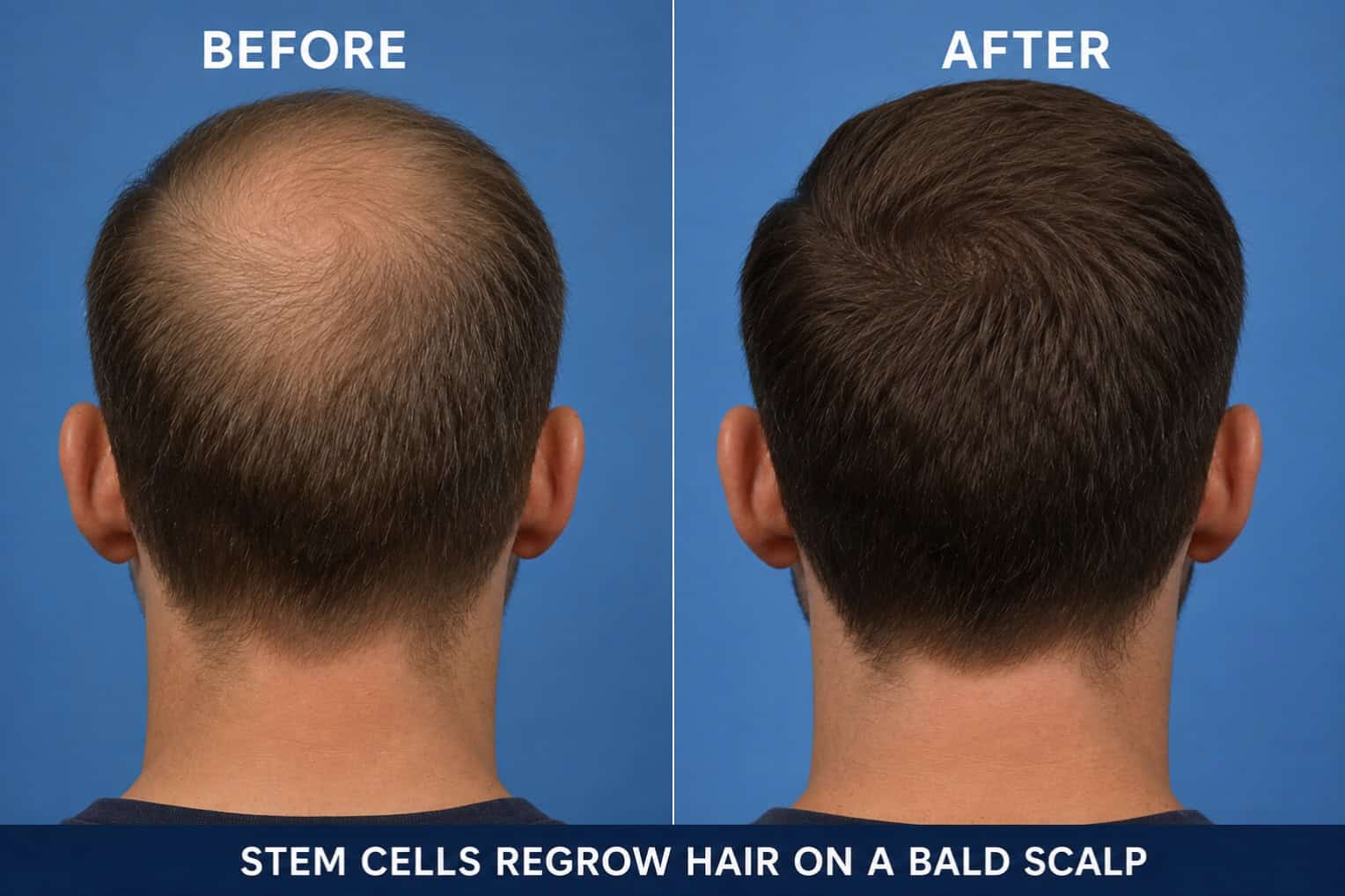
To be direct: stem cell therapy for hair loss can reactivate a dormant follicle, but it cannot create a new one where none exists. These are two very different situations. Before discussing treatment plans or costs, it’s important to find out which situation applies to each area of your scalp.
Why Candidacy Comes Before Treatment
Not every scalp is a good candidate for stem cell therapy for hair loss, and that’s not a marketing caveat it’s basic follicle biology. Two patients can both describe themselves as “losing hair” and be in completely different clinical categories underneath the surface.
The Question Every Patient Actually Asks
Almost nobody researching stem cell therapy for hair loss asks about mechanism first. They ask about outcome: will it work, on my scalp, at my current stage of loss. That question can only be answered after a proper assessment not before.
Why a Generic Answer Fails Most Patients
A blanket “yes, stem cell therapy for hair loss regrows hair” ignores the fact that hair loss isn’t one condition it’s a spectrum from mild thinning to fully non-viable follicles. Treating the whole spectrum the same way is how patients end up disappointed.
Understanding Follicle Miniaturization
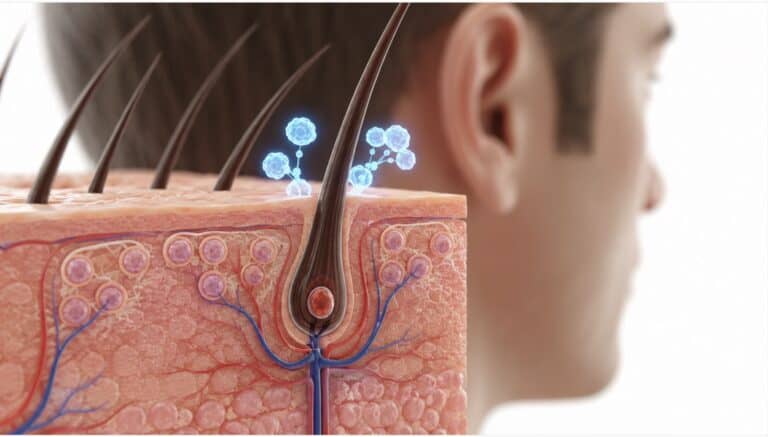
Hair follicles don’t switch off overnight. In androgenetic alopecia, follicles that are genetically sensitive to dihydrotestosterone (DHT) go through a slow shrinking process each growth cycle, the follicle produces a slightly shorter, finer, less pigmented hair than the cycle before. A thick terminal hair gradually becomes a fine, pale, vellus-like hair over years, not weeks. This is the biological backdrop every discussion of stem cell therapy for hair loss has to start from.
Stage One: The Follicle Is Still There
A miniaturizing follicle is a live structure, just an underperforming one. It’s still connected to blood supply, still has a dermal papilla, and still cycles through anagen (growth) and telogen (rest) phases it’s just producing a shadow of what it used to. This is the population that regenerative, growth-factor-based approaches are actually working with: a follicle that’s structurally intact but functionally suppressed.
Stage Two: The Follicle Is Gone
Further along the same process, some follicles stop producing any visible hair at all. Left long enough, an empty follicular opening can scar over or fill with keratin debris, at which point there’s no structure left to revive because there’s nothing left to signal to. This is the point past which stem cell therapy for hair loss has nothing left to work with, and it’s also the point most patients don’t clearly know they’ve reached until someone examines the scalp properly.
How Candidacy for Stem Cell Therapy for Hair Loss Is Assessed
This isn’t guesswork, and it shouldn’t be a visual estimate from across a consultation room. Determining candidacy for stem cell therapy for hair loss is a specific diagnostic process, and understanding what a clinician looks for tells you a lot about how honest a given assessment is likely to be.
Trichoscopy as the Diagnostic Standard
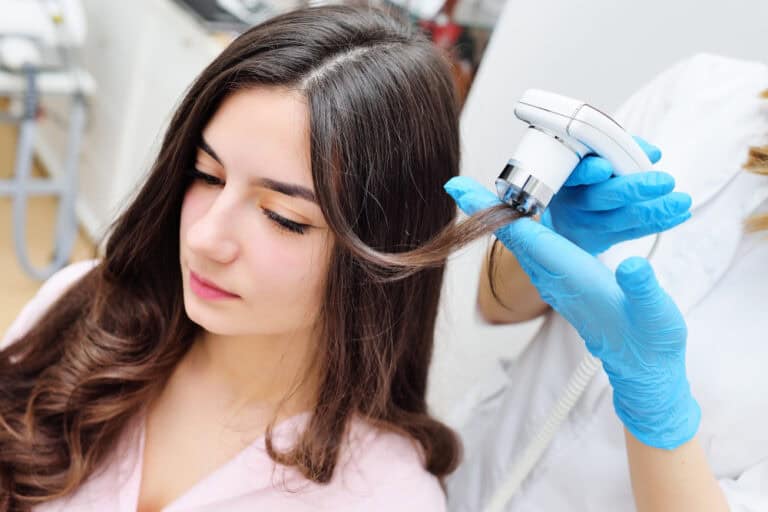
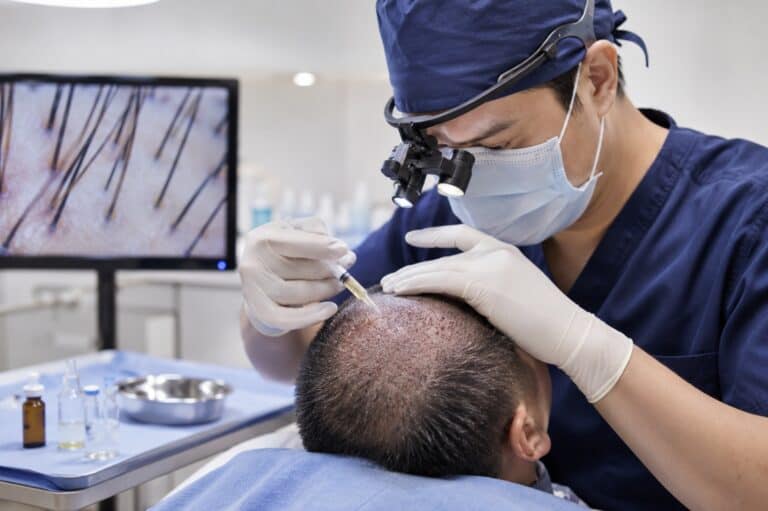
Trichoscopy dermatoscopic examination of the scalp, typically at 20x to 70x magnification is the primary tool for assessing candidacy for stem cell therapy for hair loss. It lets a clinician see individual follicular units and hair shafts directly, rather than judging density from a distance. A proper trichoscopic exam covers several defined areas of the scalp frontal, mid-scalp, vertex, and a stable occipital reference zone because androgenetic alopecia doesn’t progress evenly. The pattern of loss itself is diagnostic.
The Miniaturization Ratio
A key measurement from a trichoscopy exam is the terminal-to-vellus hair ratio. This shows how many normal, thick terminal hairs there are compared to fine, miniaturized vellus-like hairs in a certain area. On a healthy scalp, this ratio is usually about 4:1 or higher. If the ratio drops to 3:1 or lower, it can indicate active miniaturization and help determine whether stem cell therapy for hair loss might be effective in that area. Another important factor is hair shaft diameter diversity, which measures how much hair thickness varies in a sample. If this diversity is above about 20%, it is a strong sign of androgenetic alopecia, which differs from other causes of hair shedding.
Yellow Dots and Empty Follicle Signs
Trichoscopy also checks for yellow dots, which are follicular openings that appear as small, pale, or yellowish spots. These appear when the follicle underneath is either very small or empty, filled with keratin and sebaceous debris instead of a hair shaft. Seeing a few scattered yellow dots is common in typical androgenetic alopecia. However, if many yellow dots are evenly distributed in an area, it suggests that more follicles have stopped producing hair, and stem cell therapy for hair loss is less likely to show visible results there.
The “Shiny Scalp” Sign
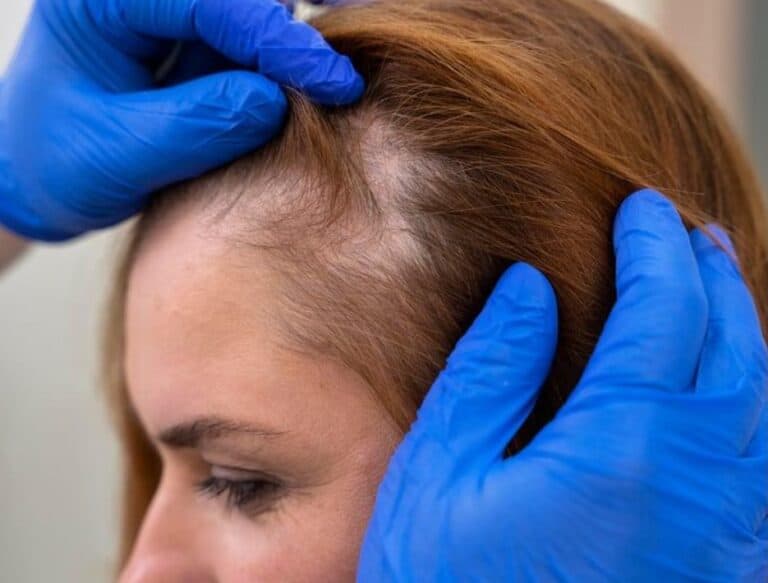
Patients often describe a smooth, tight, and shiny area on the scalp, instead of one dotted with fine hairs when viewed under angled light. Clinically, this “shiny scalp” appearance correlates with a high yellow-dot density and a very low terminal-to-vellus hair ratio. While this is not a diagnosis by itself, it is usually not a positive sign. Areas like this should always be checked with trichoscopy before considering stem cell therapy for hair loss.
The Three Candidacy Tiers for Stem Cell Therapy for Hair Loss
Put those diagnostic pieces together and the candidacy picture becomes much clearer than a simple yes or no.
Tier One: Strong Candidate
High terminal-to-vellus ratio, low yellow-dot count, hair shaft diversity present but moderate. This is the zone where a follicle population is thinning but still structurally active. This group is the most likely to see a meaningful response from stem cell therapy for hair loss, because there’s still a live structure to influence.
Tier Two: Uncertain Candidate
Low terminal-to-vellus ratio, dense yellow dots, visible shiny-scalp areas beginning to appear. This is advanced miniaturization tipping into follicle loss. Stem cell therapy for hair loss applied over this area is working with a shrinking population of viable targets, and results become progressively less predictable the further the area has progressed.
Tier Three: Not a Candidate for Regeneration
Confirmed empty, non-viable follicular units. At this point there is no follicle left to revive. This is the honest cut-off: no injection, infusion, or growth-factor protocol reactivates a structure that’s no longer there. A hair transplant which relocates viable follicular units from a donor area rather than attempting to regenerate ones that are gone becomes the only route to restoring visible density in that specific area.
Stem Cell Therapy for Hair Loss vs. Hair Transplant: Two Different Tools
These two approaches aren’t competing options for the same problem they solve different problems, and a trichoscopic assessment is what decides which one actually applies.
When Regenerative Therapy Is the Right Tool
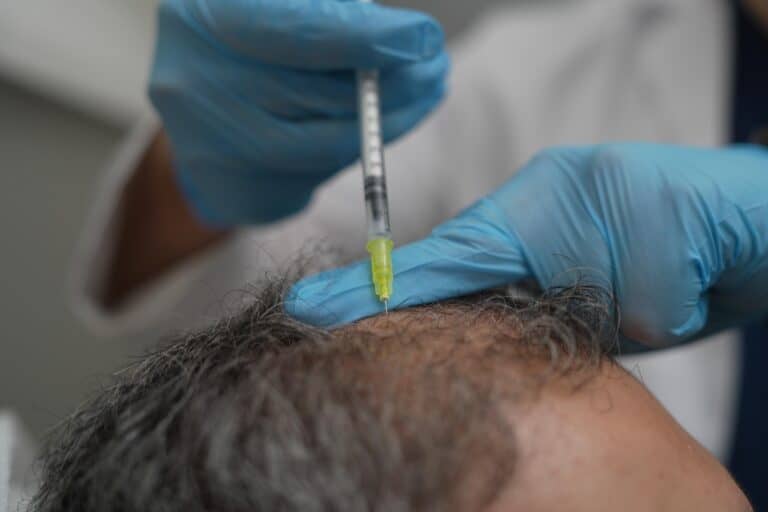
Stem cell therapy for hair loss is suited to areas with confirmed viable, miniaturizing follicles, Tier One, and cautiously, parts of Tier Two. Here, the goal is functional recovery of an existing structure.
When Transplantation Is the Right Tool
Where trichoscopy confirms Tier Three non-viable, empty follicular units transplantation is the only approach that restores visible density, because it relocates follicles rather than attempting to revive ones that no longer exist.
Frequently Asked Questions About Stem Cell Therapy for Hair Loss
Does stem cell therapy for hair loss work on a fully bald scalp?
Not on areas where follicles are confirmed non-viable. Stem cell therapy for hair loss works on follicles that are miniaturized but still structurally present not on scalp where the follicular structure itself is gone.
How do I know if I'm a candidate for stem cell therapy for hair loss?
Candidacy is determined through trichoscopy, which measures the terminal-to-vellus ratio, yellow-dot density, and hair shaft diameter diversity across defined scalp zones. This should happen before any treatment discussion, not after.
Can stem cell therapy for hair loss be combined with a hair transplant?
Yes, in mixed-presentation cases where some zones are still viable and others aren’t stem cell therapy for hair loss and transplantation can address different areas of the same scalp rather than being treated as mutually exclusive options.
What happens if stem cell therapy for hair loss is used on non-viable follicles?
Little to no visible regrowth, because there’s no structure left for the treatment to influence. This is why candidacy assessment matters more than the treatment protocol itself.
Choosing a Clinic for Stem Cell Therapy for Hair Loss
When it’s performed by an experienced physician under proper medical standards, the overall risk is low especially when the cells or extract come from the patient’s own body rather than a donor source.
Choosing a Clinic for Stem Cell Therapy for Hair Loss
Clinics offering stem cell therapy Bangkok Thailand patients travel for should be running and showing trichoscopic assessment as a standard part of consultation, not an optional add-on. If a provider is willing to quote a protocol for stem cell therapy for hair loss before examining the scalp under magnification, that’s worth noticing. The honest answer to “will this work at my stage” starts with a dermatoscope, not a treatment menu.
The Bottom Line
The honest version of this conversation isn’t a sales narrative. A patient with genuinely active, structurally intact miniaturization is a fundamentally different candidate for stem cell therapy for hair loss than a patient with years of established, empty follicular units and offering the same regenerative protocol to both, without distinguishing between them first, sets up the second patient to be disappointed by a treatment that was never going to work on tissue that wasn’t there anymore.

The Vega Derma Medical Team consists of board-certified dermatologists, specialized trichologists, and clinical researchers based in Bangkok, Thailand. Our team specializes in evidence-based regenerative dermatology, complex tissue repair, and advanced hair restoration (including precision FUE and FSE). Every protocol and article we publish is medically reviewed to ensure it meets international clinical standards, providing safe, science-backed guidance for our local and international patients.