
Key Takeaways:
- Twenty minutes of cool running water is the single most effective thing anyone can do at the scene. Registry data from a bi-national burn cohort found first aid cooling was associated with reduced burn injury severity, including lower rates of graft surgery.
- Burns continue to deepen for up to 48 hours after the injury. What looks minor on day one can be considerably worse on day three, which is why review matters.
- The two to three week rule governs scarring. Hypertrophic scarring is considered close to inevitable when a burn takes longer than about three weeks to close, and longer than two weeks in children and in patients with darker skin.
- Silicone gel or silicone gel sheeting is the internationally recommended first-line treatment for preventing and treating hypertrophic burn scars, supported by randomised controlled trials.
- Pressure therapy prevents scars rather than treating established ones, so referral should happen at the first sign of hypertrophic scarring, not months later.
- Fractional ablative laser now has positive data for burn scar treatment, and ablative fractional lasers generally require fewer sessions than non-ablative options.
- Sun protection on newly healed skin should continue for up to two years. Permanent hyperpigmentation can occur in new epithelium exposed to direct sunlight, which is a serious consideration in Thailand.
If this is happening right now
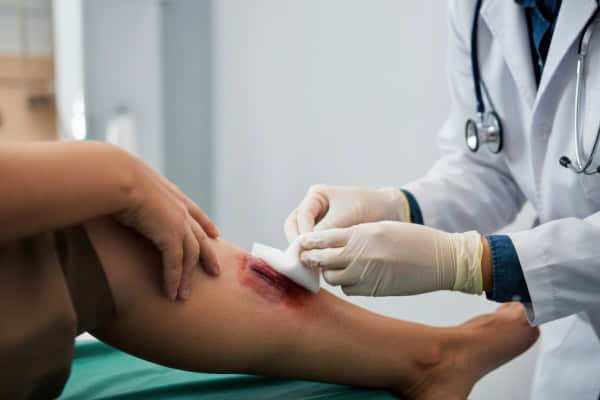
- Cool the burn under cool running water for 20 minutes. Start as soon as possible. Cooling still helps if begun within three hours of the injury.
- Do not use ice, iced water, toothpaste, fish sauce, butter, oil, or herbal pastes. Ice causes blood vessels to constrict, which can deepen the burn or cause a cold injury.
- Remove clothing and jewellery from the area unless it is stuck to the skin. Swelling comes quickly.
- Call emergency services (1669 in Thailand) or go to hospital immediately for large burns, burns to the face, hands, feet, genitals or joints, burns that go all the way around a limb, chemical or electrical burns, any burn in a child, or if smoke was inhaled.
This article is educational. It does not replace emergency care. Vega Dermatology & Wound Care Unit is an outpatient clinic and does not provide emergency burn treatment. We support smaller outpatient burns, post-hospital recovery, and treatment for burn scars.
Burn first aid, and why 20 minutes is the number
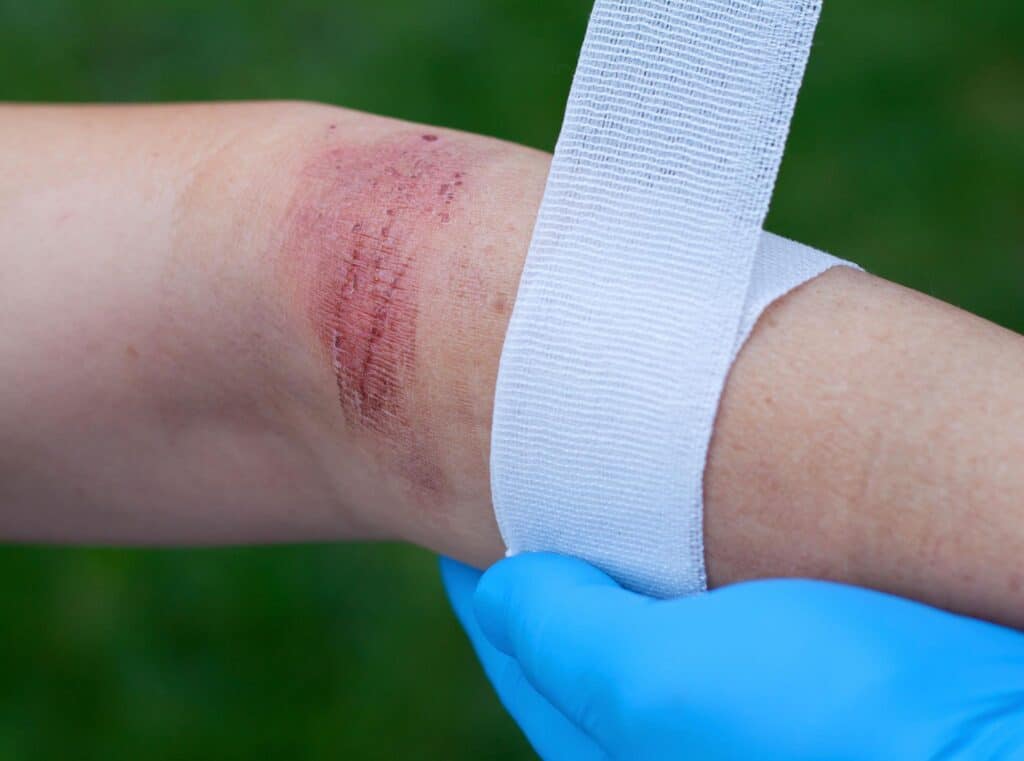
A burn is not a single event. Heat continues to transfer into tissue after the source is removed, and the injury can progress in depth over the following 48 hours. Prompt first aid limits how far that damage travels.
Cool running water at roughly 8 to 25 degrees Celsius for at least 20 minutes has been shown to reduce burn depth. If cooling is started within three hours of the injury, it reduces pain and swelling, slows cellular metabolism in oxygen-starved tissue, dampens the inflammatory response, and improves wound healing while reducing scarring.
A prospective cohort study drawing on the Burn Registry of Australia and New Zealand analysed patients treated between 2009 and 2012 and found that first aid cooling before arrival at a burn service was associated with reduced injury severity across measured outcomes.
Cool running water dissipates heat better than a cold compress. Ice and iced water should be avoided because vasoconstriction can deepen the burn or cause a cold injury.
After cooling:
- Cover loosely with cling film laid over the wound, not wrapped tightly around a limb, or with a clean non-fluffy cloth
- Keep the person warm overall, since prolonged cooling of a large burn can drop body temperature dangerously
- Do not burst blisters
- Take simple analgesia if there is no contraindication
- Seek medical review, even if it looks minor
When a burn needs hospital or specialist care
Not every burn can be managed at home or at a general emergency department. Referral to a specialised burn centre is recommended for:
- Burns to the face, hands, feet, genitals, or across joints, because of the risk of functional impairment and scarring
- Suspected inhalation injury, suggested by facial burns, singed nasal hair, or smoke exposure in an enclosed space
- Burns in children, due to the complexity of pain and wound management and the need to screen for non-accidental injury
- Electrical burns, including low-voltage ones, because internal damage can appear days later
- Chemical burns
- Large burns by total body surface area
- Circumferential burns encircling a limb or the chest
- Any burn expected to take longer than 14 days to heal, because of hypertrophic scarring risk
That last criterion is the one most often missed in general practice, and it is the one that determines whether a patient ends up with a manageable scar or a disabling one.
Understanding burn depth
Burn depth determines healing time, scarring risk, and whether surgery is needed. Modern classification uses descriptive terms rather than only degrees.
Depth | Also called | Appearance | Sensation | Healing time | Scarring risk |
|---|---|---|---|---|---|
Superficial | First degree | Red, dry, no blisters | Painful | 3 to 7 days | Minimal |
Superficial partial thickness | Superficial second degree | Blistered, moist, pink, blanches on pressure | Very painful | Around 14 days | Low, pigment change possible |
Deep partial thickness | Deep second degree | Blotchy red and white, drier, sluggish blanching | Reduced sensation | Over 21 days, often needs surgery | High |
Full thickness | Third degree | White, brown, leathery or waxy, no blanching | Little or no sensation | Will not heal without grafting | Very high, contracture risk |
Depth is not always obvious in the first 48 hours, which is exactly why a burn that looks superficial on day one should still be reviewed. Reduced or absent sensation is a warning sign, not a good sign. It suggests nerve endings have been destroyed.
How burn wounds actually heal
Wound healing is not linear, and understanding the phases helps explain why scars behave the way they do.
- Inflammatory phase, days 0 to 5. Blood vessels constrict then dilate, immune cells arrive, and debris is cleared. Swelling, redness, and pain belong to this phase. Excessive or prolonged inflammation here is one of the strongest predictors of a bad scar later.
- Proliferative phase, days 4 to 21. New tissue forms. Fibroblasts lay down collagen, new blood vessels grow, and keratinocytes migrate across the wound to close it. This is where the two to three week threshold sits. If the wound closes within this window, scarring risk stays relatively low. Deeper partial thickness burns that stall here can convert into non-healing wounds, which is a different clinical problem covered on our chronic wound and skin repair page.
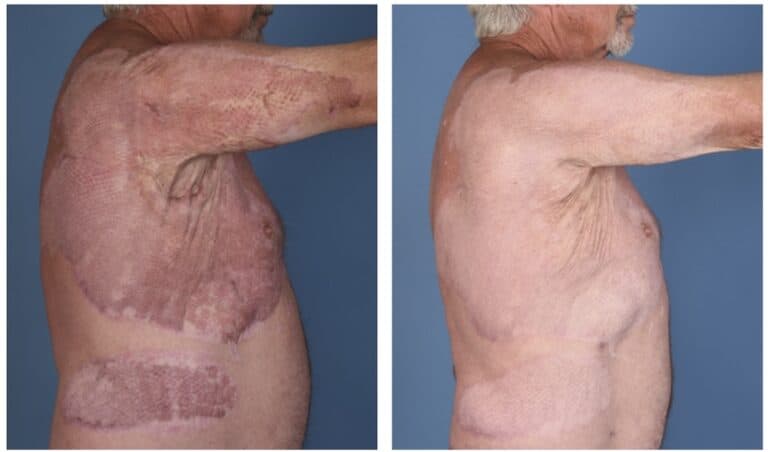
- Remodelling phase, week 3 to 24 months. The disorganised collagen laid down quickly during proliferation is gradually replaced by stronger, better-aligned collagen. A scar is at its most red, raised, and firm somewhere between two and six months, then slowly softens and fades. This is why the scar you have at month three is not the scar you will have at month eighteen, and why patience is genuinely part of the treatment.
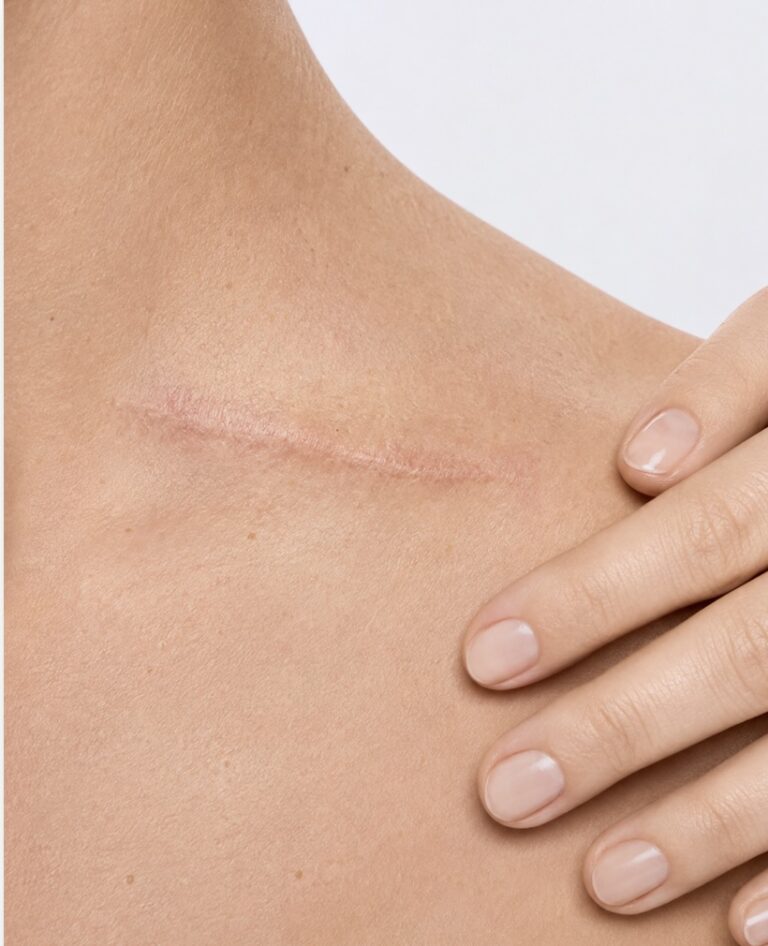
Hypertrophic scars raise because collagen production outruns collagen breakdown. They stay within the original wound boundary. Keloids extend beyond it and do not regress spontaneously, and they occur more frequently in Asian, African, Middle Eastern, and Latin American skin. That makes keloidal burn scarring a realistic risk for many patients in Thailand, and it needs a more aggressive plan than a hypertrophic scar does. See our keloid treatment page for how that differs.
Severe burn treatment: what happens in hospital
Major burn care is inpatient work, and it is worth knowing the outline so the process is less frightening.
- Resuscitation. Large burns cause massive fluid shifts. Intravenous fluid resuscitation in the first 24 to 48 hours is calculated by body weight and burn surface area, and is adjusted against urine output.
- Airway management. Inhalation injury can cause airway swelling that develops over hours. Early intubation may be needed before swelling makes it difficult.
- Wound management and debridement. Dead tissue is removed, because it feeds infection and blocks healing.
- Grafting. Full thickness burns and many deep partial thickness burns will not close on their own. Split-thickness skin grafts, and in some cases dermal substitutes, are used to achieve closure. Faster closure means less scarring.
- Infection control and nutrition. Burn patients are hypermetabolic and immunosuppressed. Nutritional support and infection surveillance are central, not peripheral.
- Early rehabilitation. Splinting, positioning, and range of movement work start early, because contractures form fast and are far easier to prevent than to release.
Treatment for burn scars
Once the skin is intact and stable, scar management begins. The evidence base here is clearer than most patients expect.
Silicone
Silicone gel or silicone gel sheeting is universally considered the first-line prophylactic and treatment option for hypertrophic scars and keloids, and international clinical recommendations support it as first-line therapy for widespread burn hypertrophic scars once the epithelium is intact and stable. It works by hydrating and occluding the scar rather than by any drug effect.
Practical points: apply to closed skin only, never to open wounds, use it for at least 12 hours a day, and continue for months rather than weeks. Gel formulations tend to have better adherence than sheeting because they are easier to use in visible areas and in a humid climate.
Pressure therapy
Custom pressure garments applied to healing burn scars are a long-standing part of burn rehabilitation. The critical point for timing is that pressure prevents scars but does not treat them once they are established. Referral should be initiated promptly at the first sign of hypertrophic scarring, or if the wound misses expected healing milestones.
Intralesional corticosteroid
For raised, firm, itchy, or painful scars, injected corticosteroid remains a mainstay alongside silicone. Concentrations used on the face and neck are usually limited to reduce the risk of skin atrophy. It is a therapeutic agent rather than a preventive one.
Fractional laser
Positive data supports the use of fractional lasers for burn scar treatment, and ablative fractional lasers offer the advantage of fewer sessions than non-ablative options. A single-centre retrospective review of 110 ablative fractional CO2 sessions across 40 adult and paediatric patients with hypertrophic burn scars found no infectious complications, no skin complications, and no unplanned admissions within six weeks of any treatment, concluding that the approach was safe and well tolerated.
Laser is used to improve pliability, reduce thickness, relieve itch, and improve range of movement across joints. It is a functional treatment as much as a cosmetic one.
Massage, moisturising, and itch control
Scar massage, consistent moisturising, and itch management are unglamorous and genuinely useful. Itch after re-epithelialisation is very common and can be treated with moisturisers, cool cloths, massage, and oatmeal preparations, with oral antihistamines as first-line for moderate to severe itch. Scratching prolongs inflammation and worsens the scar, so controlling itch is scar treatment, not just comfort.
Sun protection
Newly healed skin exposed to direct sunlight can develop permanent hyperpigmentation. Sunscreen with SPF of at least 50 should be used, and direct sun avoided, for up to two years after the burn. In Thailand this is a serious commitment and it needs to be said plainly at discharge, not buried in an information sheet.
Scar management timeline
Period | Priority | What to do |
|---|---|---|
Injury to wound closure | Achieve closure fast | Correct dressings, infection control, specialist referral if healing is slow |
Closure to week 4 | Protect fragile new skin | Moisturise, strict sun protection, no friction or trauma |
Week 4 to month 6 | Active scar prevention | Silicone daily, pressure garments if indicated, massage, itch control |
Month 3 to month 12 | Active scar treatment | Corticosteroid injection for raised scars, fractional laser for thickness, pliability, and function |
Month 12 to month 24 | Remodelling and reassessment | Continue sun protection, reassess for contracture release or reconstruction |
Warning signs during recovery
Return for review promptly if you notice:
- Increasing pain, redness spreading beyond the wound, pus, odour, or fever
- A wound that has not closed within two to three weeks
- A scar that is becoming raised, red, and firm
- Tightness that limits movement of a joint
- Numbness or shooting nerve pain, which is more common after full thickness burns
- A wound that closed and then broke down again
Contractures across joints are far easier to prevent with early therapy than to correct with surgery later.
How burn care works at Vega Dermatology & Wound Care Unit
We want to be precise about scope, because getting this wrong costs people tissue.
We are not an emergency burn service. Large burns, burns to the face, hands, feet, genitals or major joints, suspected inhalation injury, electrical and chemical burns, and any deep partial thickness or full thickness burn need a hospital burn unit first. Call 1669 or go directly. We coordinate with those teams rather than replacing them.
What we do handle falls into two phases.
- Phase 1, burn wound healing. Smaller outpatient burns, and patients discharged from a burn unit who still have open areas, fragile grafts, or wounds that have stalled. Standard care here is wound cleansing, debridement of devitalised tissue, topical antimicrobials, appropriate moisture-balance dressings, and monitoring for infection or conversion to a deeper injury. For selected stalled or complex burns we add regenerative protocols, including growth factor media intended to support angiogenesis and granulation. These sit on top of standard care rather than in place of it.
- Phase 2, treatment for burn scars and contractures. This is where most of our burn work happens, and where timing matters more than technology:
Option | How it works | Best for |
|---|---|---|
Silicone and pressure therapy | Hydration and sustained pressure | Early scar prevention, starting soon after closure |
Steroid injections | Reduces collagen deposition and inflammation | Raised, thickened, itchy scars |
Pulsed-dye laser | Targets vascularity and redness | Red, inflamed immature scars |
Fractional CO2 laser | Resurfaces and remodels collagen | Thickness, pliability, contracture support |
Surgical revision | Releases tight bands, improves contour | Mature contracture scars |
Cell-based regenerative support | Encourages more organised collagen | Selected cases, as an adjunct |
Physical therapy referral | Maintains range of movement | Scars crossing joints |
Preventive measures start as soon as the wound has closed and any grafts are stable. Laser and injections come later, once the skin is robust and infection risk is low. Complex or long-standing cases may also involve our scar and tissue remodeling service.
Frequently Asked Questions
How long should I cool a burn?
Twenty minutes under cool running water. Starting within three hours of the injury still confers benefit. Do not use ice, iced water, or any home remedy such as toothpaste, oil, butter, or fish sauce.
Do I need to see a doctor for a small burn?
Yes, if it blisters, is larger than the palm of your hand, involves the face, hands, feet, genitals, or a joint, was caused by chemicals or electricity, occurred in a child, or has not clearly begun healing within a few days. Burns can deepen over the first 48 hours, so an early assessment is worthwhile.
Why does my burn look worse two days later?
Burn injury can progress in depth over roughly 48 hours after the event. This is normal behaviour for a burn and is a reason for review rather than a sign that something was done wrong.
Will my burn scar?
Depth and healing time are the main predictors. Burns that close within about two weeks usually leave minimal scarring. Hypertrophic scarring is considered close to inevitable when healing takes longer than three weeks, and longer than two weeks in children and in people with darker skin. Early specialist input changes this outcome more than any product does.
What is the best treatment for burn scars?
There is no single best treatment. Silicone gel or sheeting is the internationally recommended first-line option once skin is intact. Pressure garments, corticosteroid injection, massage, and fractional laser are added according to the scar’s thickness, symptoms, and effect on movement. Most patients need a combination over time.
When can I start treating a burn scar?
Scar prevention starts once the epithelium is intact and stable, which is usually a few weeks after closure. Silicone and sun protection come first. Laser and injections are considered later, once the scar is established enough to assess.
Can old burn scars still be improved?
Often yes. A single-centre series of ablative fractional CO2 for hypertrophic burn scars treated patients an average of nearly four years after injury, with improvements in scar quality and no infectious or skin complications recorded. Older scars generally need more sessions and expectations should be set around pliability, thickness, and function as much as appearance.
Will hair grow back on a burned area?
It depends on depth. Superficial burns usually spare hair follicles and hair returns. Deep partial thickness and full thickness burns destroy the follicles within the injured area, and hair will not regrow there without surgical reconstruction or grafting. No topical or regenerative treatment restores a follicle that has been destroyed, which we explain in more detail in our guide to follicle repair therapy.
Why is my healed burn so itchy?
Itch after re-epithelialisation is very common and relates to nerve regeneration and dry, immature scar tissue. Moisturisers, cool compresses, massage, and oral antihistamines are first-line. Persistent severe itch deserves review, because scratching worsens the scar.
Is a keloid the same as a hypertrophic scar?
No. A hypertrophic scar stays within the boundary of the original wound and often improves gradually over months to years. A keloid grows beyond the original wound edge and does not regress on its own. Keloids are more common in Asian skin and need a different, more aggressive management plan.
References
- Lloyd ECO, Rodgers BC, Michener M, Williams MS. Outpatient Burn Care: Prevention and Treatment. American Family Physician.
https://www.aafp.org/pubs/afp/issues/2020/0415/p463.html - Morgan ED, Bledsoe SC, Barker J. Ambulatory Management of Burns. American Family Physician.
https://www.aafp.org/pubs/afp/issues/2000/1101/p2015.html - Ten Top Tips: The management of burn wounds. Wounds International.
https://woundsinternational.com/wp-content/uploads/2023/02/content_11259.pdf - Griffin B, et al. Water First Aid Is Beneficial In Humans Post-Burn: Evidence from a Bi-National Cohort Study. PMC.
https://www.ncbi.nlm.nih.gov/pmc/articles/PMC4725848/ - Mustoe TA, et al. International clinical recommendations on scar management. Plast Reconstr Surg.
https://pubmed.ncbi.nlm.nih.gov/12142678/ - Gold MH, et al. Updated International Clinical Recommendations on Scar Management: Part 2, Algorithms for Scar Prevention and Treatment. Dermatol Surg.
https://laserplast.org/wp-content/uploads/Updated_International_Clinical_Recommendations_on.2.pdf - Monstrey S, et al. Updated Scar Management Practical Guidelines: Non-invasive and invasive measures. J Plast Reconstr Aesthet Surg.
https://www.jprasurg.com/article/S1748-6815(14)00173-9/fulltext - Complications Following Laser Resurfacing of Hypertrophic Burn Scars: a Single Center Experience. Journal of Burn Care & Research.
https://www.ncbi.nlm.nih.gov/pmc/articles/PMC11958145/ - An Evaluation of Evidence Regarding Application of Silicone Gel Sheeting for the Management of Hypertrophic Scars and Keloids. J Clin Aesthet Dermatol.
https://jcadonline.com/an-evaluation-of-evidence-regarding-application-of-silicone-gel-sheeting-for-the-management-of-hypertrophic-scars-and-keloids/
This article is for general information and does not replace emergency or individual medical care. For an acute burn, call 1669 or go to hospital. For established burn scars, contractures, or wounds that are slow to heal, book a consultation with our medical team at Vega Dermatology & Wound Care Unit (Vega Derma), 3/6 The Primary 101, Lad Phrao 101 Road, Khlong Chan, Bangkapi, Bangkok 10240.

The Vega Derma Medical Team consists of board-certified dermatologists, specialized trichologists, and clinical researchers based in Bangkok, Thailand. Our team specializes in evidence-based regenerative dermatology, complex tissue repair, and advanced hair restoration (including precision FUE and FSE). Every protocol and article we publish is medically reviewed to ensure it meets international clinical standards, providing safe, science-backed guidance for our local and international patients.